Manchester Voices is a research project which explores the rich tapestry of accents, dialects, and identities that make up Greater Manchester.The project is based at Manchester Metropolitan University, and was funded by the Arts and Humanities Research Council.
Although the funded project officially ended in 2023, the work continues. We are still analysing the data, uncovering new findings, and developing new outputs. These can be explored through the Manchester Voices book, the online and library resources, and a range of other publications and activities.
There were seven strands to the project:
1. The Accent Van
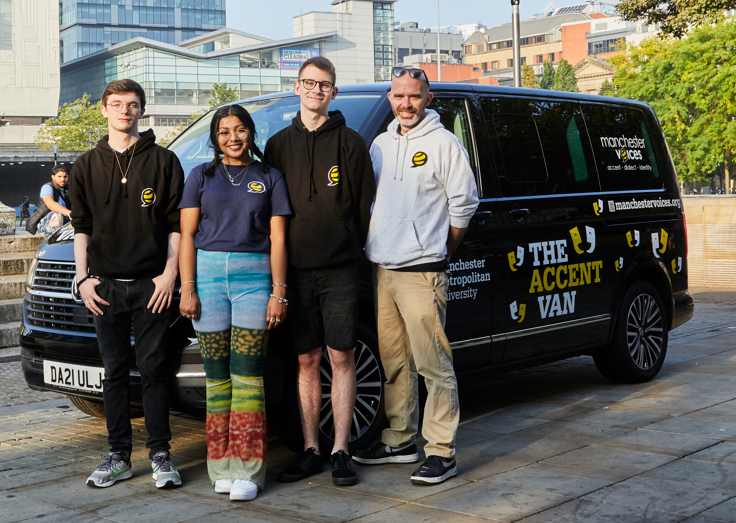
The summer of 2021 saw us out and about in our Accent Van – a specially adapted vehicle that served as a mobile interview booth and recording studio. We travelled across all ten boroughs of Greater Manchester, inviting people to take part in the project. Participants were asked to reflect on how they speak, sharing their experiences and beliefs about their own accents and dialects, as well as those of others. These conversations revealed deeply held attitudes about the status and value of different ways of speaking, and the relationship between spoken language and local identity. The interviews provided us with both linguistic data, allowing us to explore patterns of language variation, and social data, offering insights into how people feel about that variation and what it means to them.
2. Virtual Accent Van
For people who weren’t able to be out and about to visit The Accent Van, we provided the same experience online throigh our Virtual Accent Van. Participants were interviewed by our Accent Van virtual assistant, and their recordings were automatically submitted to us when they finished.
3. Online mapping of people’s perceptions
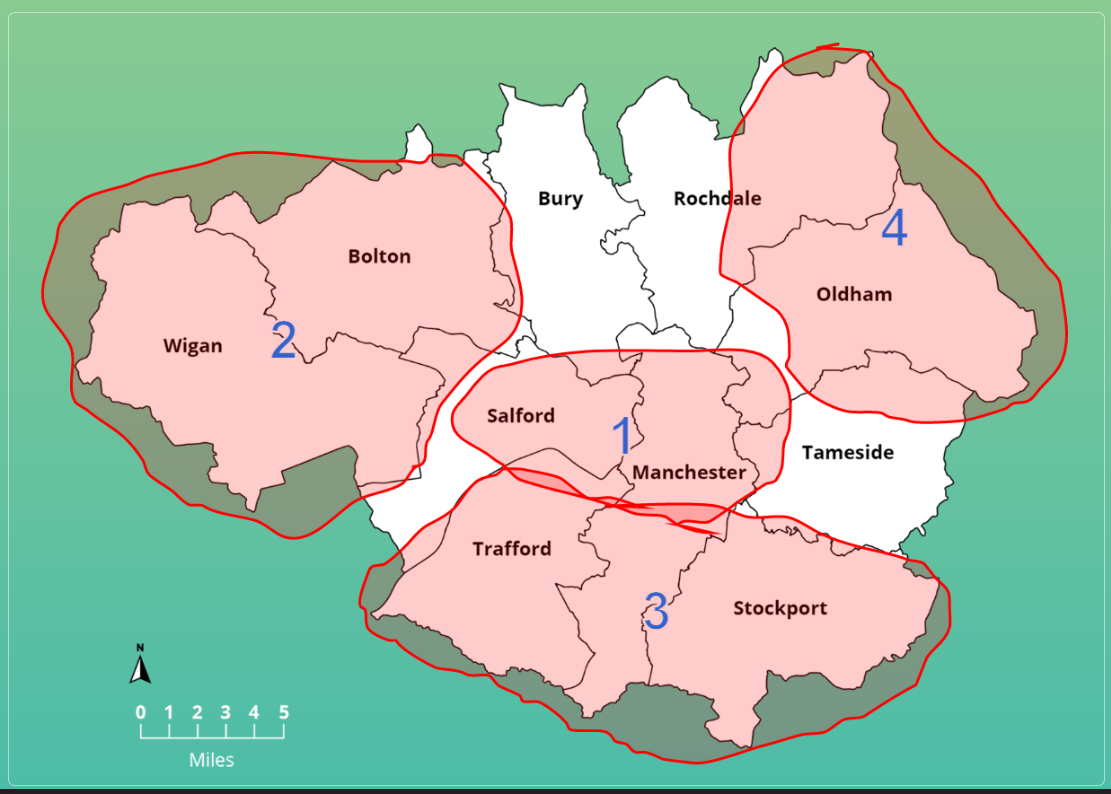
Regional accents and dialects are closely tied to ideas of place and belonging. This strand of the project explored the sociolinguistic landscape of Greater Manchester, helping to advance our understanding of the region’s diverse accents, dialects and identities. Using a specially designed online tool, participants were invited to draw digital maps showing where they felt people spoke differently across Greater Manchester. They were also asked to name and describe the dialects they identified, and to provide examples of sounds, words and grammatical features that they associated with particular areas. The resulting map data was analysed using GIS (Geographic Information Systems) techniques, enabling us to create heat maps showing where different dialects were perceived to be spoken and where perceptions of dialect variation were shared across the region.
4. Directions task and pronunciation maps
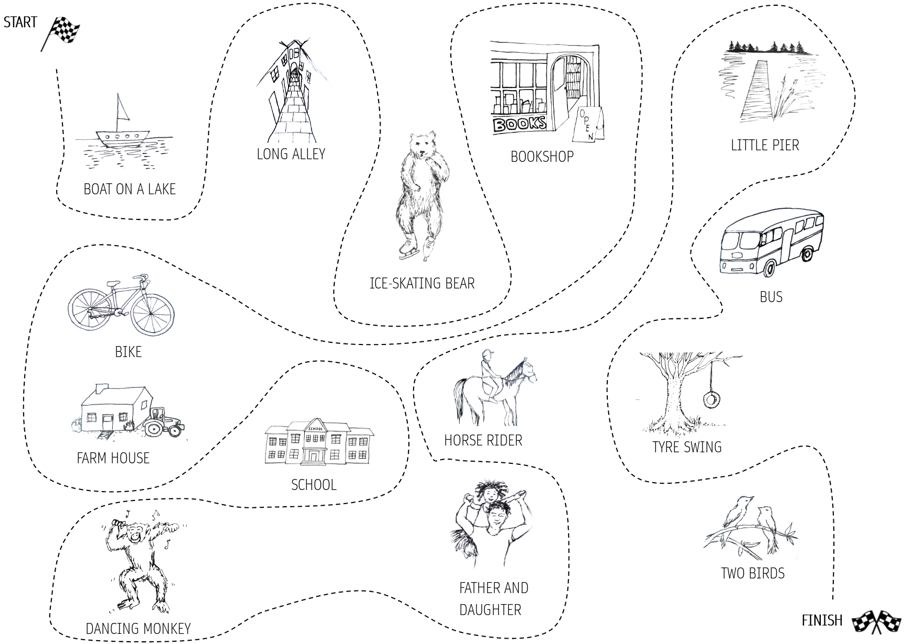
We asked people to take part in a task where they described the route along a map, navigating their way past landmarks which were designed to elicit particular words and sounds. We used these recordings to investigate small differences in pronunciation across the ten boroughs of Greater Manchester.
5. Language attitude surveys
Early in 2021, we ran the Accent Attitudes Quiz, in which participants listened to recordings of speakers from across Greater Manchester, rated them on a series of scales, and attempted to identify where they were from. The survey provided valuable insights into people’s perceptions of and attitudes towards the speech of the region.
Investigating attitudes towards accents and dialects is crucial to understanding how linguistic features are used, maintained and sometimes lost within communities. Attitudes help to reveal the social meanings attached to particular sounds, words and grammatical forms, and shed light on how language relates to identity, belonging and social relationships. The findings from the quiz enabled us to explore the ways in which people from different boroughs, linguistic and cultural backgrounds, and age groups perceive both their own speech and that of others, as well as the assumptions and associations they make about speakers themselves.
6. ‘Talking About Voices’ podcast resource and competition for schools
Talking About Voices is an opportunity for secondary school pupils in Greater Manchester to learn about audio production while also reflecting on issues around language and identity. The objective is for pupils to make a short podcast episode about language and identity, with plenty of ideas, training and support provided along the way. The materials can be used remotely, as well an in class. You can find out a bit more about this part of the project on the Talking About Voices website (talkingaboutvoices.org).
7. Analysing historical recordings from the region
Unlocking Our Sound Heritage was a major project led by the British Library and its partners across the UK, including Archives+ at Manchester Central Library. Funded by the National Lottery Heritage Fund as part of the wider Save Our Sounds programme, it sought to preserve and provide access to half a million rare and unique sound recordings from across the UK. As part of the Manchester Voices project, we worked with Archives+ to transcribe and analyse recordings from across Greater Manchester. This provided a unique opportunity to compare the speech of people born at the turn of the twentieth century with that of speakers from the present day, offering valuable insights into language change across the region.
The Manchester Voices team
Manchester Voices is run by Professor Rob Drummond at Manchester Metropolitan University. The project was originally set up by both Rob Drummond and Dr Erin Carrie, with Dr Sadie Ryan working with us until Dec 2021, and Dr Holly Dann and Dr Sarah Tasker working with us until August 2022. Dr Caitlin Halfacre joined the team from Mar 2024-Sep 2025. We were also supported by more than 20 Manchester Met students.
To contact the project, please email Rob at R.Drummond@mmu.ac.uk